

Exhausted Electricity
How the Department of Energy is being restructured to make America a petrostate and "win" the AI race

Shortly after Jimmy Carter was inaugurated as President in 1977, he signed the Department of Energy Organization Act, which established the Department of Energy. The new department consolidated a patchwork of independent agencies that had struggled to respond to the oil shocks of the 1970s. Economic and geopolitical risks of dependence on a single, volatile commodity obviated the need to bring coherence to a fragmented regulatory state. Later that year, President Carter submitted the National Energy Plan to Congress, which laid out five approaches to the energy dilemma and three overriding objectives:
The NEP, along with accompanying messages to the Congress, detailed five recommended approaches to the energy dilemma:
Conservation and fuel efficiency.
Rational pricing and production policies.
Reasonable certainty and stability in Government policies.
Substitution of abundant energy resources for those in short supply.
Development of nonconventional technologies for the future.
The President stated that a combination of these approaches would help realize three overriding objectives:
The immediate objective of reducing United States’ dependence on foreign oil and consequent vulnerability to supply interruptions.
The medium-term objective of keeping United States’ imports sufficiently low to weather the period when world oil production approaches its capacity limitations.
The long-term objective of having renewable and essentially inexhaustible sources of energy for sustained economic growth.
Since its inception, the Department of Energy’s long-term objective has been forward-looking. It was intended to sanction the spoils of inexhaustible, abundant, and democratized energy to sustain economic growth. That is to say, renewable energy.
Yet, with Chris Wright at the helm, the Department of Energy has been reshaped around two priorities: transforming the United States into a petrostate and “winning” the AI race. However, these goals are not only incompatible with each other but fundamentally at odds with DOE’s statutory mission of delivering affordable, reliable energy to American consumers.
Reorganization as Fascism
On November 24, the Department of Energy announced a sweeping restructuring effort to “Strengthen Efficiency and Unleash American Energy,” framed as an attempt to “strengthen DOE’s ability to execute President Trump’s bold agenda to restore American energy dominance.” In a follow-up statement, Wright explained that the department was aligning itself to “restore common sense to energy policy.”
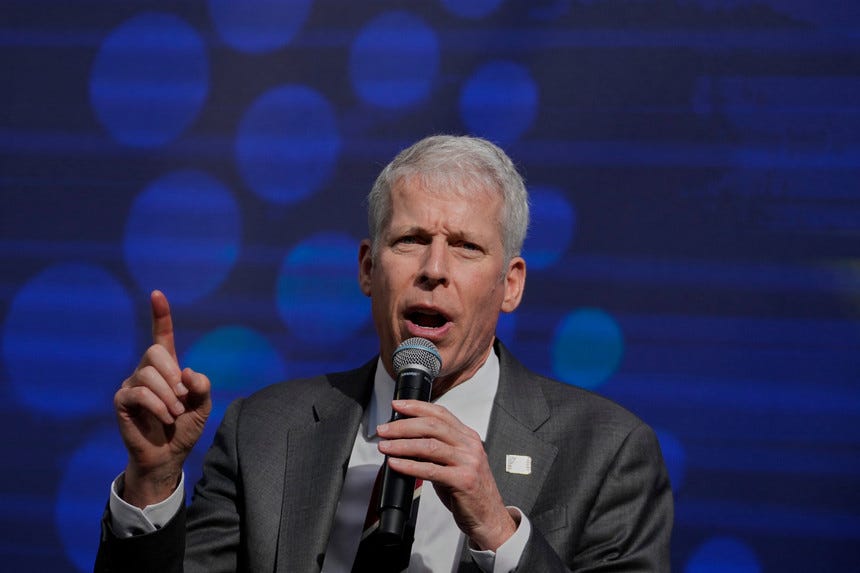
Notably absent from the statement is a definition of “American energy dominance,” however, his language gives us a few hints. The word “unleash” imagines a powerful force restrained by unnatural barriers. Yet “restore” indicates a temporality; that there was once a golden age that has been sabotaged by ideological excess. “Common sense” casts complexity as decadence and expertise as obstruction. Together, these words construct a myth: that fossil fuels’ domination is natural, renewable energy represents an unnatural imposition, and this should be obvious.
This imagery is not coincidental; it is a rhetorical inversion meant to portray oil, gas, and coal as heroic, masculine, and productive. In contrast, solar, wind, and batteries are cast as suspicious, overintellectualized, and foreign. It allows the powerful to imagine themselves reclaiming their rightful place at the top of a natural hierarchy that has been subverted. It is fascism.
Because, in reality, the American energy Wright describes as restrained receives over $700 billion in explicit and implicit subsidies annually, according to an IMF study. American cities, infrastructure, and electricity markets have been designed around their needs. Our imperialist adventures abroad (both historical and very recent!) have largely been carried out to secure access to oil reserves. Wright’s mission requires mythology because it is not supported by empirical, historical, or political reality.
Patterns in the DOE Reorganization
The American Federation of Scientists cataloged the organizational changes as follows:
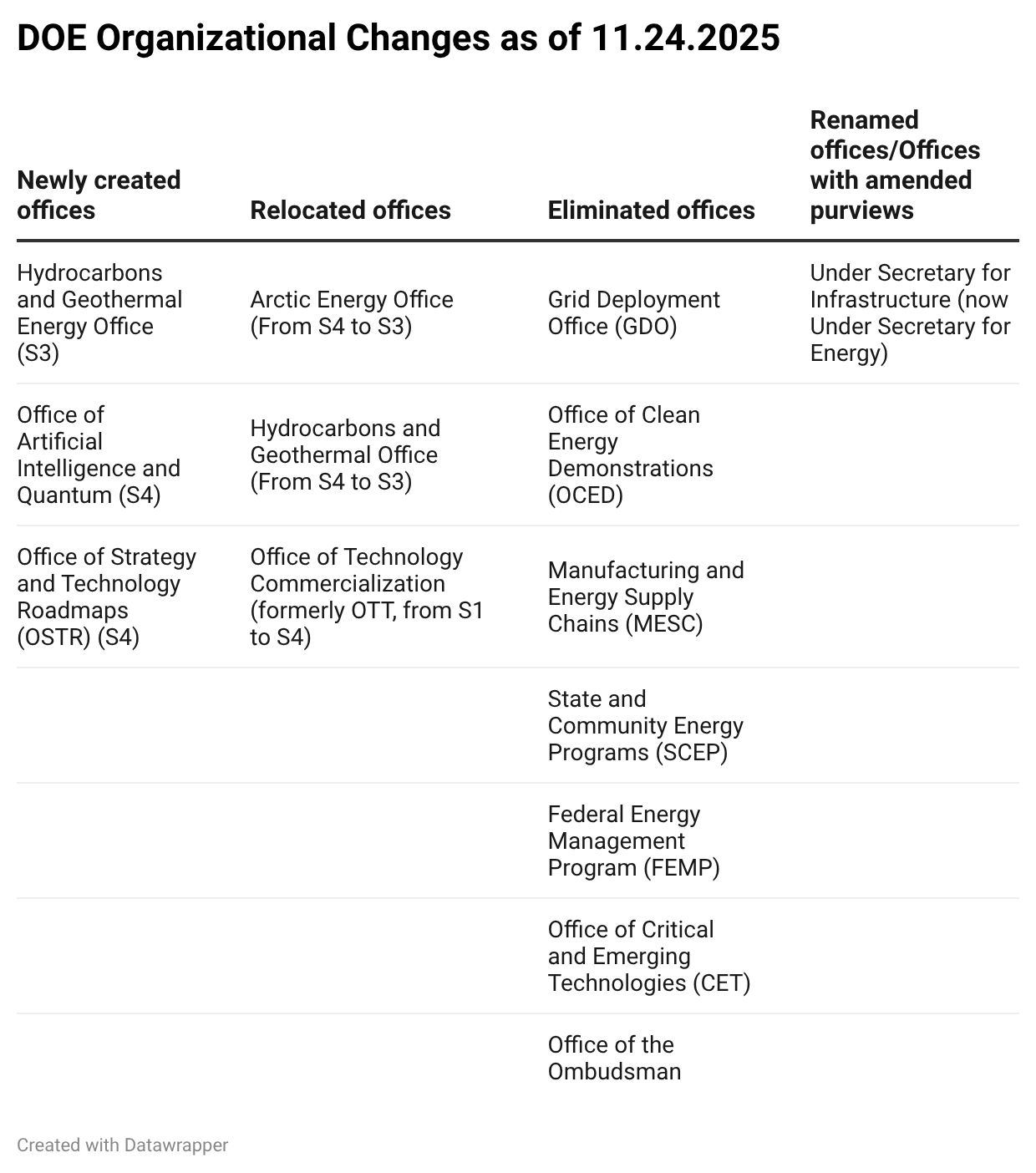
There are several clear patterns here:
Renewable energy is explicitly deprioritized: Key offices on renewable energy, one of which has been around since the 1970s, have been eliminated, removed, or stripped of authority.
AI and data centers are elevated rhetorically, but undermined materially: Replacing renewable energy offices with offices dedicated to supporting AI expansion undermines the actual infrastructure needed for data center deployment. Renewable energy remains the only near-term option to serve data center electricity needs (source). More kindling is added to hype flames, which will put near-term stress on the electrical grid and increase prices. More food for thought on the Trump Admin’s recent actions related to data centers:
The Trump Administration recently issued an executive order attempting to override any state-level AI regulation laws.
The Wall Street Journal recently reported that Trump Administration officials are clashing with state regulators over threats to take control of parts of the electric grid to speed up data center interconnection. State’s rights, anyone?
Disregard of the complexity of the energy economy: Offices dedicated to grid reliability, supply chains, and long-term planning are dismantled under the banner of “common sense,” which presumes that solutions are visible to those with superior acumen, rather than worthy of further study. This mirrors the broader technocratic contempt for regulatory expertise visible in initiatives like DOGE.
Masculinity signaling: Why is it necessary to change the name of the Loan Programs Office to the Office of Energy Dominance Financing? To ensure funding is not provided to renewable energy projects! Project 2025 makes this intention explicit on page 384.
Funding Cuts vs. Reality
The Department of Energy has also materially targeted transmission and clean energy projects. With the support of Senator Josh Hawley, the $5 billion loan for Grain Belt Express was canceled in July. Here is what the DOE had to say:
“It is not critical for the federal government to have a role in supporting this project.”
It is curious, then, that the Missouri Public Service Commission had found the project would save ratepayers nearly $17 billion. Increased connectivity and capacity on the transmission grid would lead to more energy coming online, which would certainly benefit tech companies seeking to energize their data centers. The project aligns well with the stated goals of delivering affordable energy to American consumers and winning the AI race. If the DOE wanted to succeed by any means necessary, support for this project would not be a question. It is a contempt for the possibility of renewable energy expansion that drives this decision. The DOE is curtailing investment in the very infrastructure that would successfully power the AI expansion because renewables would be deployed, not fossil fuels.
Indeed, the DOE cancelled $700 million in funding for battery manufacturing projects earlier this fall. Again, the DOE claims:
“The projects had missed milestones, and it was determined they did not adequately advance the nation’s energy needs, were not economically viable, and would not provide a positive return on investment of taxpayer dollars.”
Batteries provide grid reliability and management services, which are critical for the deployment of data centers. Additionally, one of Trump’s central campaign promises was a domestic manufacturing resurgence. The projects supported by this funding would have created manufacturing facilities in Kentucky and Missouri, and hundreds, if not thousands, of jobs. Again, the DOE’s contempt for non-fossil fuel energy conflicts with the delivery of affordable, reliable, and secure American energy, their ultimate goal of winning the AI race, and the wider Trump regime agenda. Making America a petrostate is incompatible with reality.
Economic Consequences
Dismissing renewable energy weakens the United States’ ability to address climate change, ultimately shifting higher economic and environmental costs to us. Climate change is not an abstract future risk; it already affects public health through rising air pollution, disruptions to food systems, more frequent and severe extreme weather events, and the displacement of vulnerable communities. Continued expansion of fossil fuel infrastructure will intensify these harms, with the greatest burden falling on populations that have the fewest resources to adapt, both globally and within the United States.
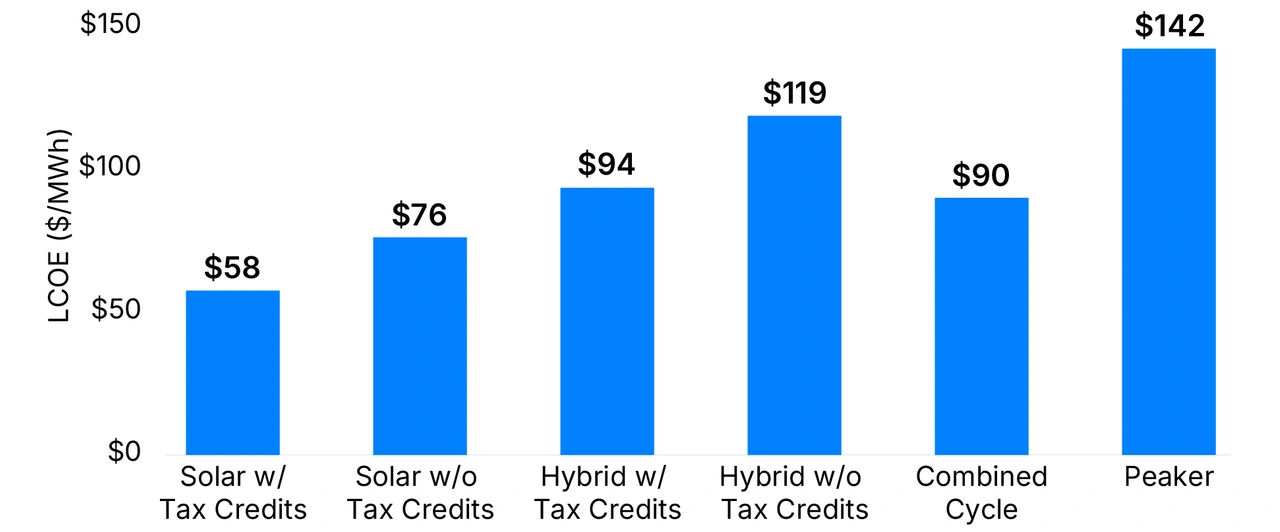
Beyond these environmental costs, the pure economics are straightforward: solar energy is cheaper than gas. As shown in the graph below, the research firm Orennia compares the levelized cost of electricity—a metric that allows for apples-to-apples comparisons between different energy sources. Even without tax credits, utility-scale solar now undercuts combined-cycle natural gas. In other words, resistance to renewable energy is a political choice that pads private, corporate fossil fuel interests, rather than reducing environmental and economic costs for consumers. And, in the context of rising electricity demand due to data centers, these political choices cannot be understood as anything but grievance-driven.
Aesthetic Contrasts
On the DOE’s social media, subtext becomes text. There, they attempt to draw an aesthetic contrast between fossil fuels and renewable energy. Coal, drilling, and oil are cast as cool and powerful, and renewables are portrayed as unreliable, ugly, and suspicious. The primary function
of this reaestheticization is to create a visual vocabulary to address consumer discontent. When the incoherence of this approach to energy politics reaches its logical conclusion — rising prices, worsened climate change, and technological lags — it will be blamed on renewables.


Conclusion
Chris Wright would like us to believe that fossil fuels have been and always will be the only way to serve our energy economy. But we don’t have to look too far into the past to realize that he is wrong, and his mission is destined for failure.